
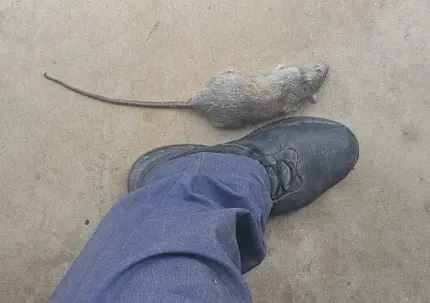
When the first cool nights arrive, mice and rats aren’t sitting still. They’re already moving, following temperature gradients through walls and foundations toward whatever warmth they can find. Most homeowners don’t notice until they hear scratching above the ceiling or spot droppings near the pantry. By that point, the rodents aren’t exploring your home anymore. They’re nesting in it.
Chad Highley, owner of Environmental Pest Control, is an Associate Certified Entomologist (ACE), a credential earned through the Entomological Society of America that requires passing a rigorous exam on insect and pest biology. That background shapes how our team looks at a property. A fall exclusion inspection isn’t about caulking what’s visible and moving on. It’s about understanding what’s driving rodents toward your home in the first place and why Ardmore homes, along with homes all over Oklahoma and Texas, face entry risks that national pest control templates never account for.
Why Homes Become Rodent Targets Once Fall Hits
The National Pest Management Association estimates that rodents invade roughly 21 million U.S. homes each winter as outdoor temperatures fall. Rodents carry pathogens including salmonella and hantavirus, a potentially fatal respiratory illness transmitted through contact with rodent droppings, urine, or nesting material.
Oklahoma and Texas mild winters compound the problem. In colder climates, outdoor rodent populations drop when temperatures stay below freezing for extended stretches. Here, winters stay warm enough that populations remain active and keep multiplying well into the season. A pair of mice that makes it inside in October doesn’t go dormant. They breed. A female mouse can produce six to ten litters per year under the right conditions, and “inside a warm wall cavity in a home” counts as the right conditions.
Where Norway Rats & Roof Rats Find Their Way Inside
Not all rodents take the same path into a structure, and understanding the difference changes where you look for problems. We identify Norway rats and roof rats as the two most problematic species across our Oklahoma and Texas service area, and their behavior is nearly opposite.
Norway Rats
These are the heavy-bodied, ground-dwelling rodents most people picture when they think of a rat. Norway rats dig burrow systems and prefer lower-level entry points: foundation cracks, gaps around utility penetrations at grade, basement vents, and crawl space openings. Once they’ve established a burrow near a foundation, they’ll work a gap methodically until it’s large enough to use.
Roof Rats
Roof rats are agile climbers. They travel along tree limbs, fence lines, and utility wires to reach upper-story entry points: gaps in rooflines, unscreened vents, deteriorating fascia, and openings around HVAC lines that penetrate the attic. They nest in insulation, which compresses and loses R-value as they tunnel through it, and they chew through wiring in ways that aren’t always visible until an electrical fault develops.
Early signs worth taking seriously: droppings near food storage areas, gnaw marks on wood or wiring, and scratching or scurrying sounds in walls or attics. Both species are most active at dusk and through the night.
Why Oklahoma’s Clay Soil Creates Entry Points That Don’t Stay Closed
Ardmore, and other cities within the region, sits on clay-rich soil that expands when it absorbs moisture and contracts as it dries. This cycle puts constant pressure on foundations across Carter County and beyond. As soil shifts beneath a slab or pier-and-beam structure, it can open settlement cracks in concrete and masonry that weren’t there the previous spring.
That matters because the gap thresholds are surprisingly small. A mouse can compress its body through a hole roughly the size of a dime. A rat needs only about a quarter-sized opening. A settlement crack that looks minor to a homeowner walking the perimeter is a functional door for either species. Generic sealing checklists don’t account for this because they’re written for a national audience, not for a region where the ground is actively creating new access points season after season. A fall inspection here includes a close look at the foundation perimeter and anywhere utilities or drainage features meet the slab, not just the obvious gaps around doors and windows.
What Professional Exclusion Actually Involves
Rodent exclusion means identifying and physically sealing the access points rodents use or could use to enter a structure. Our approach follows integrated pest management (IPM) principles, which prioritize understanding and eliminating the conditions that attract and sustain pests over simply reacting with chemical treatment.
In practice, that means pairing entry-point sealing with habitat modification, addressing the conditions around and inside a home that make it attractive to rodents: dense vegetation against the foundation, clutter near exterior walls that creates harborage, improperly stored food, and moisture sources that draw rodents in before they ever look for a gap to exploit. When exclusion is paired with habitat modification, you’re removing both the path and the reason to take it.
Because Chad holds an ACE credential, the inspections our team performs are grounded in pest biology rather than a route-based checklist. That shapes which entry points get priority, how we interpret activity signs, and what treatment (if any) is applied and where. Our goal is solving the problem for good.
Why Sealing Now Beats Waiting for a Bigger Problem
There’s a practical window for fall exclusion work, and it closes faster than most homeowners expect. Once temperatures drop and rodents have established themselves inside a structure, the work shifts from prevention to active removal, which takes longer and costs more. Sealing entry points before the first sustained cold snap is a one-time investment against a problem that will repeat every fall if the access points stay open.
We’ve served Ardmore and the surrounding region as a family-owned operation since 1998, and we’re licensed in both Oklahoma and Texas. Our approach has always centered on responsible, strategic methods, and we stand behind our work with the goal of actually solving the problem, not just reducing it temporarily.
If you’ve noticed new gaps around your foundation, heard something moving in the attic, or want to get ahead of a problem before it starts, now is the right time to schedule an inspection. Reach our team at (877) 414-7478.